
Полезное:
Как сделать разговор полезным и приятным
Как сделать объемную звезду своими руками
Как сделать то, что делать не хочется?
Как сделать погремушку
Как сделать так чтобы женщины сами знакомились с вами
Как сделать идею коммерческой
Как сделать хорошую растяжку ног?
Как сделать наш разум здоровым?
Как сделать, чтобы люди обманывали меньше
Вопрос 4. Как сделать так, чтобы вас уважали и ценили?
Как сделать лучше себе и другим людям
Как сделать свидание интересным?

Категории:
АрхитектураАстрономияБиологияГеографияГеологияИнформатикаИскусствоИсторияКулинарияКультураМаркетингМатематикаМедицинаМенеджментОхрана трудаПравоПроизводствоПсихологияРелигияСоциологияСпортТехникаФизикаФилософияХимияЭкологияЭкономикаЭлектроника
Topic: Logical equivalence
|
|
Definition: two compound statements A and B are said to be logically equivalent if they always have the same truth table. We denote it by 
Ex: 
Note: in the truth table of A and B, the statement variables must be placed in the same sequence, in order to compare tables correctly.
Theorem 2: The compound statements A and B are logically equivalent if and only if the compound statement A ↔ B is a tautology. (In a sense, A and B are logically “equal”.)
Laws of propositional algebra are the examples of logically equivalent statements.
Let p, q and  be the statement variables, let t denote any tautology and let с denote any contradiction.
1. Properties of c and t:
1.1 p ˅ c ≡ p 1.2 p ˄ t ≡ p
1.3 p ˅ t ≡ t 1.4 p ˄ c ≡ c
2. Properties of negation:
2.1 ~ t ≡ c 2.2 ~ c ≡ t
2.3 p ˅ ~ p ≡ t 2.4 p ˄ ~ p ≡ c
2.5 ~ (~p) ≡ p
Other lows (properties of connectives) are also familiar from the set algebra and the 2-element. Boolean algebra: commutative, associative, idempotent, distributive, De Morgan’s laws. For example, property 1.1 says the following:
- “any statement p or any permanently false statement с is a true statement if and only if p is true”.
- “the truth value of any statement p is the same as the value of p or false statement c, never mind what are the meanings of p and c.”
Now we can talk about propositional algebra:
{set of propositions} + { ˅, ˄, ~}. It’s laws are just patterns for making compound statements (sentences of natural language) with the same truth values.
Note:
- In propositional algebra connectives “→” and “↔” are considered as shorthand notations for some compositions made of ˅, ˄, ~.
- “≡” replaces the words “have the same truth values (= truth table)”.
Using these properties it is possible to transform statements of natural language without changing their true/false value.
Ex1: Given a compound statement:

Write the negation of this statement:
 | |||
 |
Ex2: Statement:
 Write this negation:
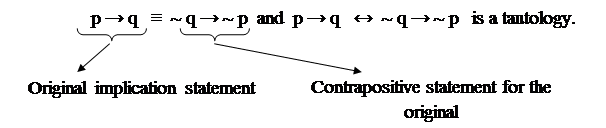
Ex3: Prove that:
 | |||
 |
|
 |
It’s contrapositive statement:
 (Why? Because we proved in Ex3 that both p → q and ~p → ~q have the same truth table. Our common sense tells the same here.)
Ex4: Given
It is certainly true.
 It’s contrapositive statement is also true (by Ex3).
 Ex5: Prove that:
In this case it is easier to use the contrapositive statement, which is
 “If n is not odd then n2 is not odd” ≡ “If n is even the n2 is even”
 Proof of this statement: If n is even then n = 2k for some int k. Now n2 = (2k)2 =4k2 = 2 * (2k2). So n2 is even.
|
|
|


|
Proof: It is easy to check by making truth tables that p ↔ q ≡ (p → q) ˄ (q → p).
So in order to prove the original statement (theorem), we must prove both “If n2 is odd then n is odd” is true and “If n is odd then n2 is odd” is true.
The first statement (p → q) was proved in Ex5.
So we just prove here the statement “If n is odd then n2 is odd”. If n is odd then it must have the form n = 2k+1 for some int k. But then n2 = (2k +1)2 = 4k2 +4k +1. Hence, n2 is odd. This is the proof of the statement (q → p).
Date: 2015-12-11; view: 413; Нарушение авторских прав